Характеристики изображения:

  • Разрешение: 4000×2667 @ 300×300 DPI 33,87×22,58cm
  • Размер: 6.45 MB
  • Добавил: Better_Call_Paul , 7 лет назад
  • Дата снимка: 07.05.2019
  • Статус изображения: Принято

Все изображения являются чьей-либо собственностью.

Если вы считаете, что пользователи сайта ошиблись, разместив данную картинку в этом разделе, то было бы здорово, если бы вы написали об этом в комментариях и указали на ошибку.

Поделиться своей радостью, обсудить наболевшее и просто поболтать об автомобилях и не только вы можете на нашем форуме.

Комментарии

2 года назад
Wheels&Tracks

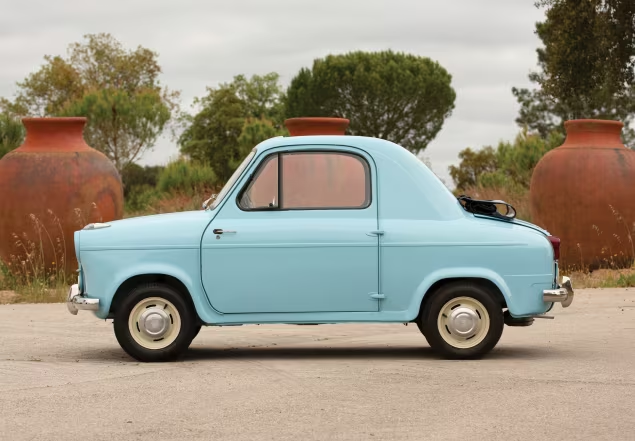
At the peak of the success of the Vespa, Piaggio decides to make an entrance into the world of the four-wheeler, still in the optic of producing an economic vehicle for a wide market. Once again it was Corradino D’Ascanio who set to designing the little Vespa 400, a two-stroke car built in two versions. After its debut in 1957, 30,000 models were produced by A.C.M.A., Piaggio’s French licensee, and in 1959, it even ran in the Monte Carlo Rally. Its 394 cc two-stroke engine, its two seats, and its rather Spartan accessories made the Vespa 400 the forerunner of the utility vehicles which invaded the roads of Europe during the sixties.

ENGINE – A rear-mounted, air-cooled, two-cylinder, two-stroke engine driving the rear wheels;

BORE – 63 mm;

STROKE – 63 mm;

DISPLACEMENT – 394 cc;

MAX SPEED – 90 Km/h;

SUSPENSIONS – independent four-wheel;

BREAKS – hydraulic on all four wheels.

https://www.museopiaggio.it/en/models/1-vespa/17-400

Чтобы иметь возможность оставлять комментарии, необходимо зарегистрироваться или войти на сайт с помощью учётной записи в одной из социальных сетей

AutoWP.ru '2005–н.в.